
LITERATURE EDUCATORS ASSOCIATION OF THE PHILIPPINES, INC. (LEAP, INC)
SEC. REG. No. CN201701311
TIN No. 009-525-693-000
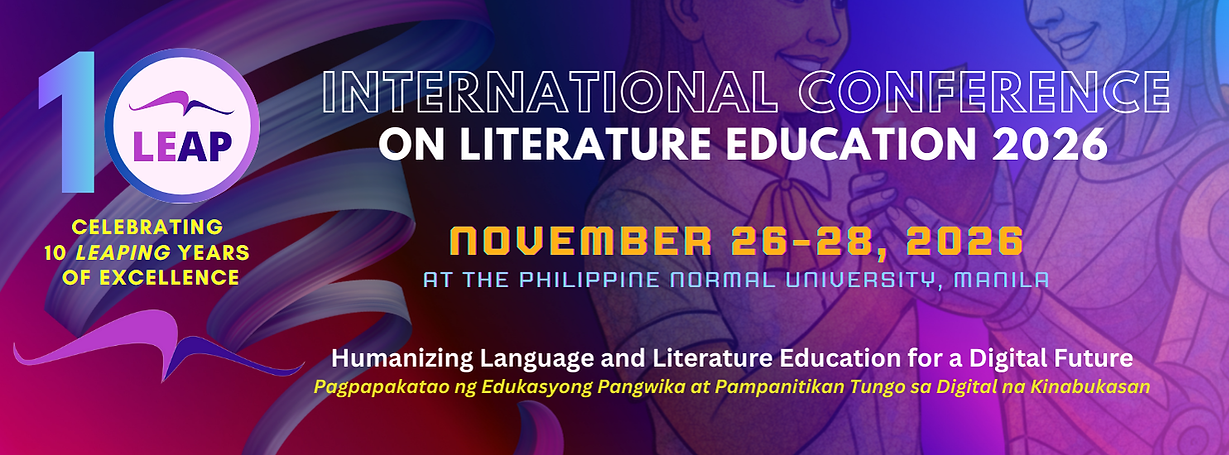

Call for Abstracts
I. Important Dates
Abstract Submission Deadline -
Acceptance Notification -
Abstract Submission Deadline (2nd call) May 31, 2026
Acceptance Notification (2nd call) -
Registration Deadline for Paper Presenters June 30, 2026
Early bird Registration for Non-presenters June 1-October 15
Full Paper Submission Deadline September 30, 2026*
Submission of Pre-Recorded Videos November 15, 2026
Conference Dates November 26-28, 2026
*For those who would like to submit their LITERARY research work in LEAP’s DALIN Journal and get a chance to win the Best Paper Award
II. Conference Stands
STRAND 1: LITERARY STUDIES (Students and Professionals)
Literary studies that discuss contemporary issues and developments, including but not limited to the following areas:
-
Applied linguistics
-
Children and youth literature
-
Comparative literature
-
Contemporary approaches to literature
-
Digital literature and new media
-
Digital humanities
-
International languages and literatures
-
Language acquisition and education
-
Literary history
-
Literary production
-
Literary publication
-
Literary theories and criticism
-
Literary traditions
-
Literature and performance studies
-
Literature/Language and Artificial Intelligence
-
Literature/Language and communication
-
Literature/Language and culture
-
Literature/Language and globalization
-
Literature/Language and other professions
-
Literature/Language and psychology
-
Literature/Language and society
-
Literature/Language and gender
-
Multilingualism
-
Multicultural literature/literacy
-
Regional languages and literatures
-
Stylistics
-
Translation studies
-
Virtual reality and immersive narratives
STRAND 2: EMPIRICAL RESEARCH ON LITERATURE EDUCATION (Students and Professionals)
Research on literature and language teaching, including but not limited to the following areas:
-
Curriculum - encompasses studies on the latest discoveries or developments in literature and language curricula across the globe
-
Competence - covers studies on the effectiveness of literature and language teaching strategies that promote the humanities, literacy and literary skills, critical thinking, and other lifelong skills.
-
Language - focuses on teaching language and linguistic features through literature that will enable students to master lifelong skills
-
Technology - covers studies on the effectiveness of teaching/learning tools and strategies on students’ critical thinking and literary competence and appreciation using technology
-
Assessment tools and/or strategies that enable literature and language educators to accurately, fairly, and/or meaningfully evaluate students’ output
STRAND 3: SHARING OF INNOVATIVE LITERATURE TEACHING PRACTICES (Professionals)
Sharing of creative teaching practices that integrate language and literature informed by theories in education and the latest trends in language and literature education; and are related to the conference theme.
It may include any of, but not limited to, the following areas of teaching:
-
increasing student engagement
-
formative and summative assessments
-
literature appreciation
-
creative writing strategies
-
motivation and enrichment activities
-
multi-disciplinary approach/integration with other subject areas
-
design of learning materials: print or online
-
questioning or discussion techniques
-
sustainable teaching practices
III. Paper Presentation Formats and Guidelines
-
The abstract should just be one paragraph with only 300-500 words. Only abstracts that are within the word limit will be accepted.
-
Papers can be written in either Filipino or English. Papers written in other languages or dialects must accompany an English translation.
-
The full paper must only be 5,000-6,000 words, including the References page.
-
Use APA (7th edition) documentation style. Include AI tools used in the References page
-
Submit the abstract and full paper in PDF format only. Please do not mention your name or other personal information in the document.
-
Only works submitted that would not receive a 15% similarity rating and above and less than 10% AI-generated content in Turnitin will be considered for paper presentation and possible publication.
-
Submit your paper through this ICLE2026.LEAPinc@gmail.com
-
Research works that fulfill all criteria below might be considered for publication in DALIN JOURNAL (if literature-related) and the Best Paper Award:
-
Less than 15% similarity index in Turnitin and less than 10% AI-generated content
-
Employed robust methodology
-
Significant contributions to/implications for the field of language, literature, and language and literature education
-
Impeccable academic writing style
-
Logical arguments, assertions, and conclusions
-
Critical choice and use of reliable sources
-
Accurate and truthful citation of sources
8. Please follow the format below for the abstract and the full paper:
-
Font: Times New Roman
-
Font size: 12 except for the Title with 14
-
Font color: all black
-
Alignment: Justified
-
Spacing: 1.0
-
Margin: 1 inch for all sides
For more information, you may click the following link: https://bit.ly/4qsugCR?r=qr